


Building the candidate's personal brand is one of the first steps in a modern political campaign. A good brand is defined by clear positioning and a consistent message conveyed through both visual and verbal communication. The image of today's politicians is less that of the aloof, formal statesman and more that of a figure who relaxes formal constraints, emphasizing relatability and authenticity instead. Platform choice is central to this process: since the target audience determines which channels are best for reaching voters, candidates must learn to play multiple instruments at once, building a flexible personal brand that lets them share one type of content on TikTok and a completely different type on Instagram or Facebook, all without losing authenticity along the way.
For example, TikTok has become a stronghold for political leaders who avoid formal, suit-and-tie-style politics. A good example is the campaign of Spanish politician Alberto Garzón, whose team turned him into a celebrity – during the campaign leading up to the 2016 Spanish parliamentary elections – by strategically sharing personal stories, Spotify playlists, and food-related posts, achieving an engagement rate of about 30 percent. Similarly, Turkish politician Ekrem İmamoğlu employed a deliberate visual strategy, bolstering his campaign in the Istanbul mayoral election with symbols of love and hope, as well as family photos. What these examples have in common is the relative de-emphasis of explicit policy content, while allowing the candidates to remain true to themselves and move comfortably within their respective roles.
Emotion as a Marketing Tool
A good product evokes emotions in potential customers; the same is true in politics. Indeed, political marketing research suggests that emotion is among the most effective tools for capturing attention and mobilizing voters - however, different platforms reward different emotional registers: Facebook’s algorithm favors dramatization, while Instagram prioritizes content that radiates happiness. Political marketers often make the mistake of focusing exclusively on the mobilizing power of negative messages, but a case study of a Colombian campaign challenges this assumption: depolarizing, conciliatory rhetoric led to a dramatic 85 percent increase in “likes,” suggesting that defusing tensions can also be a marketable political product.
Network-Based Brand Building
Just as major brands do not always attack their competitors under their own names, political campaigns also often outsource their negative messaging.
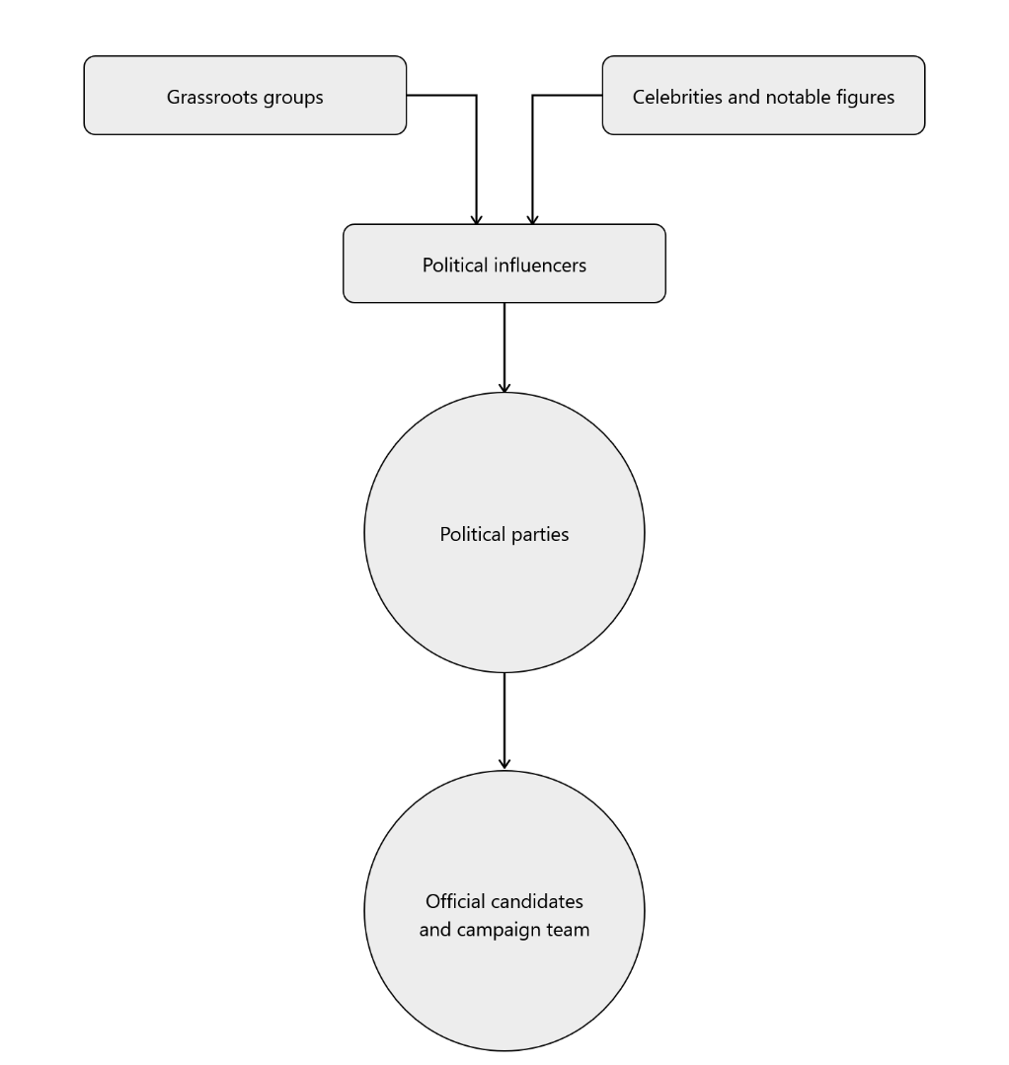
Network-Based Brand Building Model
At the center of the network are the candidate and the campaign team who controls the official brand and narrative. As we move away from the center, increasingly autonomous actors – political influencers, fan communities, and celebrities – take on much the work of mobilization and, in many cases, negative communication. A good example is Bernie Sanders’s 2016 campaign, in which supporters sought to mobilize voters through internet memes and by making politics “cool”. The groups involved in creating and sharing these memes sometimes maintained close ties with the official team, while at other times they operated completely independently.
These decentralized networks can also be activated through gamification, giving supporters an incentive to become active participants in the campaign. In Matteo Salvini's online game “Vinci Salvini!,” the fastest users to share campaign content were rewarded with a personal phone call, boosting the number of shares on Salvini's social media profile by 58 percent.
Segmentation
Since voters never form a homogeneous block, understanding the deep, individual emotions and attitudes underlying party choice lies at the heart of political campaigning. Modern campaigns therefore segment voters into micro-communities, targeting each with tailored messages for each group. One of the primary target groups worldwide is young people, who are mobilized through TikTok from Greece to Ecuador, and through meme-based campaigns, similar to Bernie Sanders’s, in the United States. At the same time, in non-Western countries, such as Kenya, messages built around ethnic, religious, and tribal identity are particularly effective.
Research has struggled to establish a direct cause-and-effect relationship between the “likes” a political post receives and the votes it actually generates. However, digital political marketing cannot be dismissed as an overhyped fad. Today, the goal of carefully constructed influencer networks is no longer immediate vote conversion, but rather the shaping of public discourse as a whole and influencing how people perceive reality. The greatest challenge of the future, therefore, is whether we, as voters, can see through this strategy. The next time a professionally tailored political post pops up on the screen over morning coffee, let’s remember: we are not obligated to buy everything the algorithms put on the shelf, and there’s no shame in questioning even our own past choices.