

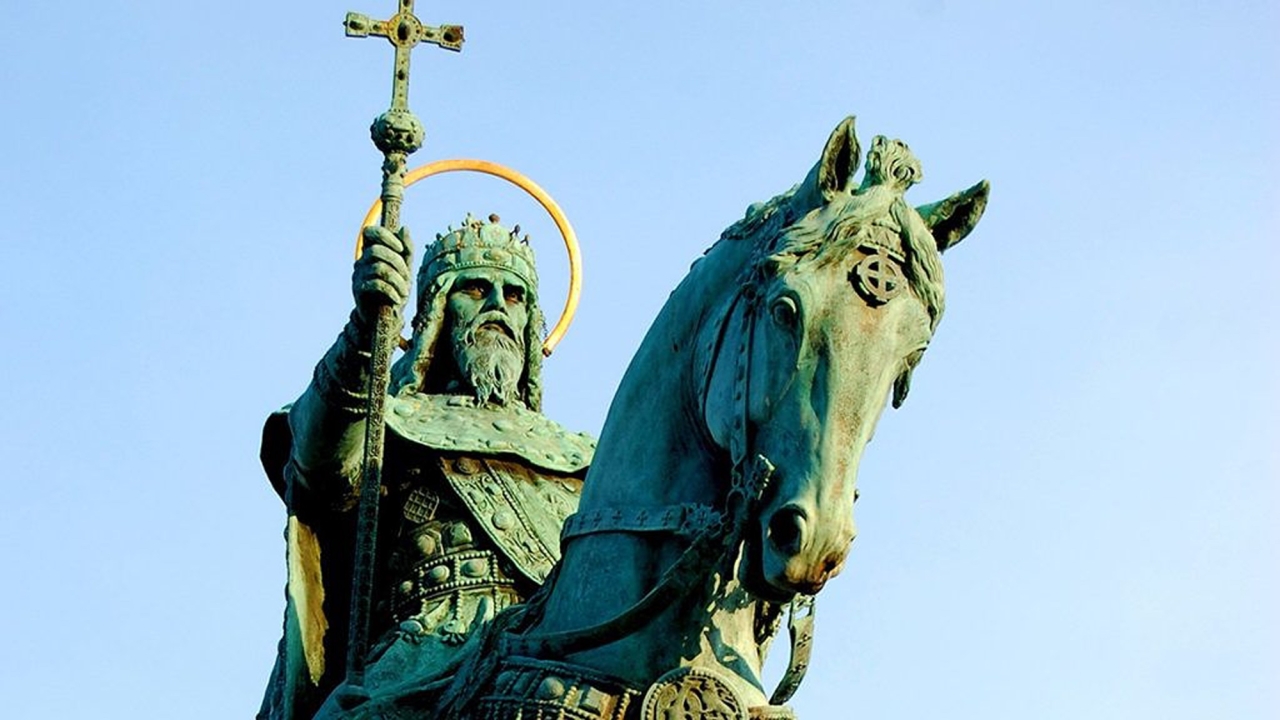
The cult of the ruler who laid the foundations for Hungary's religious organization as well as its legal and political framework was established shortly after his death in 1038, during the process of his canonization. King Saint Ladislaus, who regarded his predecessor as a role model, oversaw the canonization, which took place on August 20, 1083, in Székesfehérvár, without papal approval. Although a saint’s feast day generally coincides with the calendar date of their earthly death – their so-called “heavenly birthday” – Stephen’s feast day had to be moved by a few days. He died on August 15, which is the feast day of Hungary's patron saint, the Blessed Virgin Mary (Nagyboldogasszony), and the Feast of the Assumption of the Virgin Mary, the most important Marian feast in the Catholic Church.
In the centuries that followed, the cult of Saint Stephen spread throughout the country, primarily within the Church. Alongside Stephen, great reverence was also shown to his son Imre (Emeric), who was canonized in 1083, as well as to King László (Ladislaus), who was canonized in 1192. During the 16th century, however, the veneration of Saint Stephen underwent a significant change. The Reformation, which had taken hold in Hungary and was spreading rapidly, criticized the cult of saints, viewing it as a form of “idolatry.” In the 17th century, however, the cult of Saint Stephen once again became a key element of the Catholic revival. On the one hand, he embodied “true Christianity” in the Catholic struggle against Protestantism. On the other hand, at a time when the country was divided into three parts, the period of the state's foundation came to symbolize a lost golden age.
The reign of Maria Theresa, from 1740 to 1780, marked a milestone in the renewed veneration of Saint Stephen’s life and legacy. In 1758, the Holy See granted her and her legitimate heirs permission to use the title “Apostolic Majesty,” a symbolic distinction rooted in the legend that Pope Sylvester II had referred to Stephen as an apostle. In 1764, the queen established the Order of St. Stephen as the highest honor for distinguished service to the state. Seven years later, she had the Holy Right Hand brought back to Buda from the Dominican monastery in Dubrovnik. It had presumably been taken there earlier to protect it from the Turks. In the same year, she decreed that August 20 should be observed as a national holyday in addition to its status as a religious feast day.
The religious feast day thus gradually acquired a secular dimension, especially after Archduke Joseph, Palatine of Hungary, issued a decree in 1819 requiring representatives of cities, guilds, the military, and other organizations to participate in the celebrations. As part of the August 20 commemorations, the first Holy Right Procession took place a year earlier, in 1818. It is worth noting, however, that around this time, neither the Enlightenment’s drive toward secularization nor the nationalism that emerged with the Hungarian national awakening was conducive to the cult of Saint Stephen. In this regard, it is noteworthy that in the works of prominent figures of 19th-century Hungarian literature, such as József Katona or Dániel Berzsenyi, ancient Hungarian virtues were embodied by the pagan Koppány, rather than by Stephen, who relied on foreigners. This portrayal could be interpreted as an expression of opposition to the Habsburgs.
After the suppression of the 1848-49 Revolution and War of Independence, the holiday did not regain its former prominence for a long time, as Saint Stephen represented a symbol of Hungary’s autonomous and independent statehood, something that ran counter to the interests of the court in Vienna. A significant change came following the Compromise of 1867. Act XIII of 1891 on the suspension of industrial work on Sundays designated August 20 as a “national holiday” and declared it a day off for factory workers. Pursuant to a decree issued by the Minister of the Interior, public buildings were first decorated with flags to mark the holiday in 1895. However, in a country as ethnically and religiously diverse as Hungary was at the time, August 20 could not become a celebration for the whole of the nation. Moreover, for Hungarians, the millennium of the conquest of the Carpathian Basin, commemorated in 1896, was considered far more significant than the millennium of the founding of the state, which fell in 1900. Although the statue of Hungary's first king features prominently on the Millennium Monument that still stands today on Heroes' Square, the central figure of the sculpture group is not Stephen, but Grand Prince Árpád, the leader of the Hungarian conquest, accompanied by his commanders.
The cult of Saint Stephen held particular significance for the right-wing, conservative regime that came to power following Hungary's defeat in World War I, the collapse that ensued, and the failure of the left-wing revolutions of 1918-19. The regime itself described its rule as “counterrevolutionary”. It represented a break with the highly secularized era of the Dual Monarchy. At the same time, it served as a response to the internationalist and anticlerical policies of the Hungarian Soviet Republic of 1919. Although the regent, Miklós Horthy, and several heads of government – including István Bethlen, Gyula Gömbös, and Kálmán Darányi – were Protestants, the proportion of Catholics in the country increased following the territorial losses resulting from the Treaty of Trianon. Before 1920, Catholics accounted for nearly half of the total population. Afterward, they made up nearly two-thirds.
Between August 18 and 25, 1926, the capital city held a week of festivities in honor of Saint Stephen, and beginning in 1927, a fireworks display on the banks of the Danube became a regular feature of the August 20 celebrations. To mark the 900th anniversary of the death of the founder of the Hungarian state, a commemorative “Year of Saint Stephen” was held in 1938. The program included the World Eucharistic Congress in Budapest, a pilgrimage of Saint Stephen’s relics across the country, and a procession on August 20 that drew some 800,000 participants.
Following World War II, however, the system of national and religious symbols that had accumulated around this holiday over the centuries stood in stark contrast to the ideology of the communist regime, which regarded 1945 as the beginning of the new Hungarian state. After the communists consolidated their grip on power in 1948, the procession in its original form was no longer permitted. Instead, the Hungarian Workers’ Party held the “Festival of New Bread.” Beginning in 1949, this was combined with Constitution Day, following the adoption of Hungary's new, Soviet-style constitution. After the suppression of the 1956 Revolution and War of Independence, government officials were well aware that the use of national symbols had to be avoided.
A cautious shift toward the religious aspects of this holiday began in the late 1960s. On August 20, 1969, the first bust depicting Saint Stephen to be unveiled after World War II was inaugurated at the Benedictine Abbey in Pécsvárad. In the summer of 1977, Pope Paul VI received János Kádár, the General Secretary of the Hungarian Socialist Workers’ Party, in a private audience at the Vatican, and in early 1978, the Holy Crown – which had been under the “custody” of the United States since 1945 – was returned to Hungary. Five years later, Hungary's most popular rock opera to date, István, a király (Stephen, the King), premiered.
On August 20, 1987, Cardinal László Paskai, Archbishop of Esztergom, consecrated the Chapel of the Holy Right Hand in Saint Stephen’s Basilica, where the relic of Hungary’s founding monarch has been venerated ever since. Exactly one year later, during a solemn Mass held in the square in front of the basilica, Paskai announced that, in agreement with the leaders of the Hungarian People’s Republic, he had invited Pope John Paul II to visit Hungary. The head of the Catholic Church eventually visited Hungary twice, in 1991 and 1996. In 1988, the Hungarian Catholic Bishops’ Conference co-organized a conference entitled “Saint Stephen and His Era” with the Hungarian Academy of Sciences and the Hungarian Historical Society.
Following the regime change in 1989, August 20 regained its rightful place among Hungary’s national holidays. In 2000, the National Assembly paid tribute to Saint Stephen and the founding of the Hungarian state through a separate piece of legislation, Act I of 2000. The law states:
“With the coronation of our first king, Saint Stephen, the Hungarian people united with the peoples of Europe in the Christian faith. Since then, Hungary has been an integral part of Christian Europe. This ensured the survival of the Hungarian people and enabled them to play a decisive role for centuries. Hungary still rests on the foundation laid by Saint Stephen, the founder of the state.”
This assessment is entirely justified. Saint Stephen carried out invaluable work in organizing the state and the Church – work that remains relevant to this day. For this, he rightly earned the praise of the late Professor Gyula Kristó, regarded as one of Hungary’s greatest medievalists. In his book on Saint Stephen, Kristó wrote:
“It is the name of Saint Stephen that has become most closely associated with Hungarian identity and, at the same time, with the Hungarians’ European identity. His name has become synonymous with the “holy king”. He is the patron saint of hundreds of churches, and the namesake for numerous settlements. He remains an enduring point of reference, a benchmark for action: the Great Beginning, the founder of the nation, the architect of the state, and the ruler who spread the Christian faith. He is the greatest Hungarian statesman who ever lived.”