



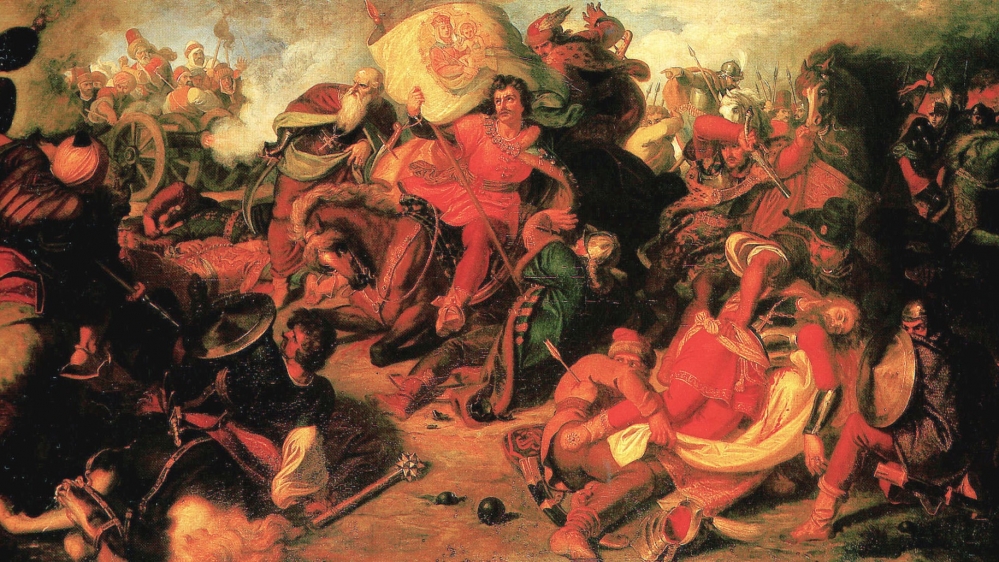

Hungarian history is full of controversial issues that give rise to opposing interpretations. The discourse on Mohács is an integral part of Hungarian national identity, as this battle has remained in the historical memory of Hungarians as a major turning point. The Debate Academy considers it important to continue the dialogue on1526 by engaging with the arguments based on current scholarship, thereby moving toward a more balanced interpretation. In our view, “Mohács was not the root cause of everything”. It was not there that the nation’s ill fate began, nor was it the event that determined the next three centuries of Hungarian history. Our position is that Mohács is not the problem, but rather a symptom of deeper underlying issues.
The Battle of Mohács was undoubtedly one of the most controversial events in Hungarian history. According to the prevailing Hungarian narrative, it was at that time and place that our country lost its former glory. The Kingdom of Hungary – built by the Árpáds, the Anjou dynasty, and the Hunyadis, and long regarded as one of Central Europe’s economic and social centers – collapsed at Mohács. There is a tendency to seek someone to blame for such national tragedies. In Hungarian public education, responsibility for the disaster is often placed on King Vladislaus II of the Jagiellonian dynasty, also known in Hungary by his nickname "Dobzse László" („King Very Well”). During his weak-handed reign, factional strife became the norm, the royal treasury was depleted, and the southern border fortresses were left to decay. With the weakening of royal authority and the dispersal of the “Black Army,” the defense of the borders—and ultimately the future of the kingdom—was put at risk. Lajos II, the young ruler who succeeded Vladislaus II, proved unable to repair the damage caused by his father. According to the traditional interpretation presented in most high school history textbooks, this led directly to Mohács. The average Hungarian citizen, drawing on their high school education, is likely to recount the events leading up to the Battle of Mohács as described above. Historians, however, have argued for decades that this interpretation – and the high school curriculum based upon it – needs to be revised. Anyone who wants to understand the causes of Hungary's decline cannot attribute it solely to a single battle or a single ruler.
In the following, we will examine two key arguments that refute the claim that “Mohács was the root cause of everything.”
Our first argument is based on an idea put forward by Pál Fodor, a Széchenyi Prize-winning Hungarian historian, who points out that assessments of the Battle of Mohács consistently fail to take into account the preceding 130 years. In our view, it would be a gross oversimplification to attribute these developments solely to two Hungarian kings. To gain a fuller understanding, we must go all the way back to the Battle of Rigómező in 1389. According to Fodor, it was there that Sultan Murad I inflicted a disastrous defeat on the Christian armies led by the Kingdom of Serbia. The first Battle of Rigómező had far more severe consequences for the decades that followed than the Battle of Mohács. As Ottoman forces advanced, Hungary’s southern borders became increasingly exposed to Turkish raids. According to Fodor, it is no coincidence that many historians regard this date as the first step on the path toward Hungary’s disintegration. From that point onward, the Ottoman armies made sporadic incursions into the territory of the Kingdom of Hungary and, subsequently, even occupied parts of it. The first Battle of Rigómező caused such damage to the strategic interests of the Kingdom of Hungary that the Jagiellonian dynasty, which came to power a century later, created relatively few additional problems. By the 16th century, the Carpathian Basin had become difficult to defend militarily. Historian János B. Szabó notes that the Jagiellons have traditionally had a poor reputation in Hungarian historical memory, as later generations blamed them for paving the way for centuries of Habsburg rule. He adds that, much like in the case of Mohács, these claims are based more on folk traditions and legends than on actual historical research. The Battle of Rigómező had a far greater impact on the course of Hungarian history than the Battle of Mohács. In this sense, B. Szabó argues that it is incorrect to claim that “everything was determined at Mohács”.
Our second argument concerns the consequences of the Battle of Mohács. If the battle was truly decisive, it is reasonable to assume that its immediate outcome would support such a conclusion. The site of the battle, the size of the opposing armies, the losses suffered by the Hungarian forces, and many other factors all weigh heavily in the assessment. However, in our view, considering the outcome, the battle itself was far less significant than is commonly assumed. In fact, the consequences for the country were not as severe as one might expect from a genuine catastrophe. The Battle of Mohács took place on August 29, 1526. Over the five centuries that have passed since then, the exact site of the battle has never been identified. This is due not only to the fact that the terrain has changed significantly since the 16th century, but also because military operations rarely take place in clearly definable settings. Previous archaeological excavations have identified several possible locations for the battlefield, suggesting that contemporaries left no precise historical record for posterity. According to modern historiography, the military engagements most likely took place somewhere south of Mohács, but it is impossible to specify the exact location. One thing is certain, however: the town as it stands today was not directly affected by the battle. Our second argument seeks to demonstrate that, from a military standpoint, the Battle of Mohács was not as devastating a defeat as often believed. However, this statement holds true only with regard to the immediate defeat. From a military perspective, the defeat suffered there would have been significant only if the Kingdom of Hungary had immediately lost control of all its territories and the Ottoman Empire had conquered most of the Carpathian Basin.
However, the scale of the battle was outstanding. Approximately 25,000 troops were deployed on the Hungarian side, while at least 60,000 were deployed on the Ottoman side. Armies of this size would not appear again for centuries, until the Napoleonic Wars. As Pál Fodor has pointed out, battles involving such large numbers of people and extending across several square kilometers tend to develop focal points and zones of greater intensity rather than clearly defined battlefields. This suggests that the battle fought near Mohács was a large-scale military operation reminiscent of modern warfare and was certainly a highly significant event from a military-historical perspective. B. Szabó also noted that, since the 19th century, Hungarian historical memory has shown strong desire to identify sites of major battles and has even fostered a kind of cult around them. We seek out the sites of our glorious past where crosses may be erected. However, the battlefield we are searching for probably does not exist – at least not in the form we imagine. Archaeologists have not uncovered a mass grave where a fitting monument could be erected allowing one to declare with certainty: “Here lie fifteen thousand brave warriors who gave their blood and their lives for God and the homeland". Our expectations of battlefields simply do not match reality. Although the Battle of Mohács was undoubtedly significant from a military-historical perspective, it was not this event alone that determined the subsequent centuries of Hungarian history.
Therefore, in our view, the answer to the question of whether “the centuries-long ill fate of Hungary truly began at Mohács” is no. Rather, the defeat shattered a myth. The 130 years preceding the Battle of Mohács proved that, even under unfavorable geopolitical conditions, it was possible to take on the Ottomans and, though with difficulty, maintain a fragile balance. As Pál Fodor observed, “in 1526, all we lost were our illusions, not our homeland.”
MCC considers the dialogue on national traditions a top priority, including our perception of the Battle of Mohács. MCC’s School of Social Sciences and History regularly organizes roundtable discussions that serve as the basis for articles such as this one. The present article was inspired by a lecture series Controversial Issues in Hungarian History, where historians Pál Fodor and János B. Szabó discussed the significance of the Battle of Mohács.


