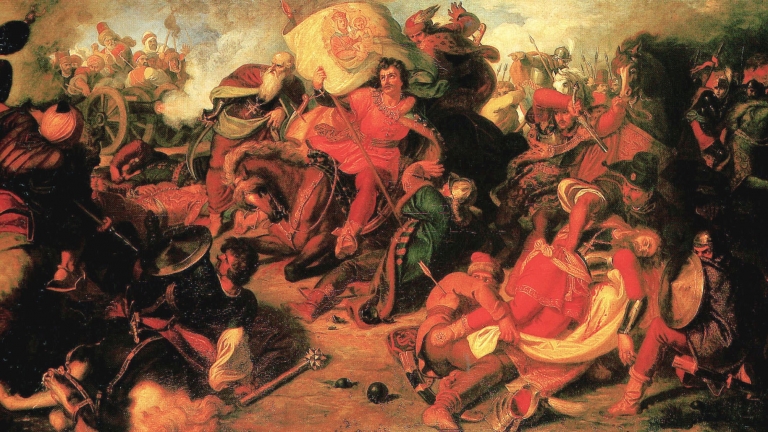

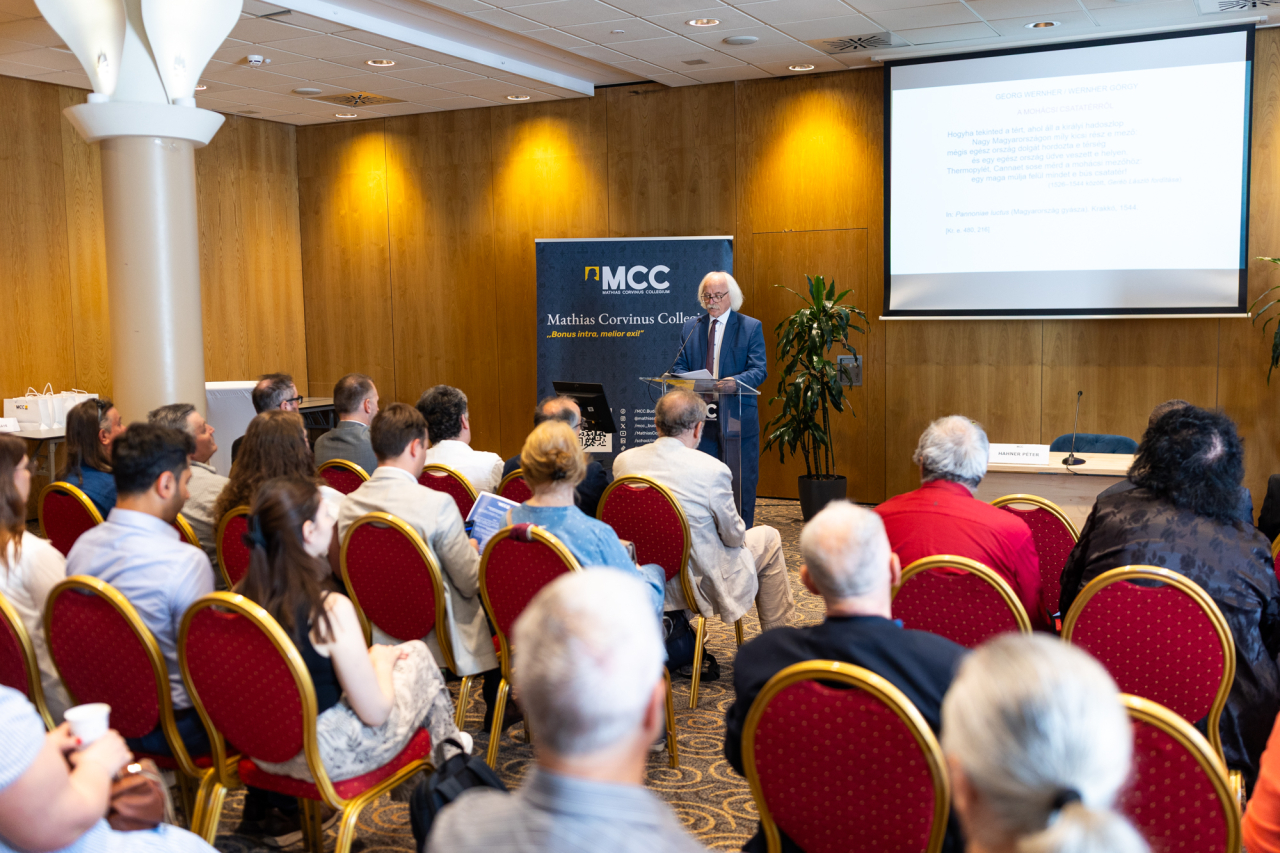
To mark 500th anniversary of the battle fought on August 29, 1526, the MCC Center for History organized a conference commemorating the sacrifice of the heroes of Mohács and the tragic fall of the medieval Kingdom of Hungary. As part of the anniversary commemorations, prominent Hungarian and Turkish scholars specializing in the period presented their latest research findings at this prestigious academic gathering.
In recent years, scholars have made significant efforts to develop a more nuanced understanding of the Jagiellonian period (1490–1526), and the MCC conference reflected this broader perspective. Alongside political and diplomatic history, the program featured presentation on church, economic, and military history as well as discussions of the Battle of Mohács in Turkish and Hungarian national memory.
Special emphasis was placed on reassessing the role of the Fugger family. Research presented at the conference showed that the arrival of the banking and merchant dynasty in Hungary had a positive impact on domestic copper production and, in particular, on the sale of the country’s mined metals. Combining the mining expertise of the Thurzó family, who played a leading role in Hungarian copper production with the Fugger family’s international trading network and financial capital, the two families established a thriving business. Following a dispute, however, Louis II confiscated the mines that had been pledged to the Fuggers. It soon became apparent that the business could not function without the family’s extensive commercial network, prompting the king to invite them back to Hungary.
This cooperation was all the more necessary after the fall of Nándorfehérvár in 1521, when the financial circle associated with the Fugger family emerged as the principal creditor of Louis II and, indirectly, of the kingdom’s defense system. Much of the Hungarian aristocracy and the higher clergy also depended heavily on Fugger loans. One of the conference’s key conclusions was that the historical basis for the conspiracy theories surrounding the Fuggers – recurring theme in Hungarian historical memory for centuries – is exceedingly weak. This is underscored by the fact that in 1526, the family not only extended loans, but also provided the royal court with additional capital to support the kingdom’s war effort.
Contributions of the Turkish historians also highlighted the futility of searching for scapegoats or blaming internal enemies. On the plains of Mohács, the Kingdom of Hungary, then regarded as one of Europe’s major powers, faced an empire that was arguably the foremost military power of its age. It is easy to forget that this was no longer the Ottoman Empire whose advance János Hunyadi had halted at the walls of Nándorfehérvár. During the seventy years between 1456 and 1526, the Ottomans had expanded their rule over much of the Middle East and North Africa. Hungary was unable to keep pace with this rapid expansion: King Matthias’s attempt to build a Central European empire came to an end with his death and he left no legitimate heir to the throne.
The presentations on diplomatic history made it clear that, by 1526, Hungary had little realistic prospect of receiving meaningful foreign assistance due to the unfavorable international political situation. The papacy's efforts to forge an alliance against the Ottomans proved unsuccessful. Meanwhile the Holy Roman Empire was preoccupied with the religious tensions triggered by the Lutheran Reformation and with conflicts among its princes. At the same time, the Habsburg–Valois rivalry further divided Christian Europe. After the Battle of Pavia in 1525, a weakened France sought Ottoman support against the allies of Emperor Charles V, among them King Louis II and his realms. Suleiman was able to launch his campaign against the Kingdom of Hungary under exceptionally favorable circumstances.
Few Christian rulers would have been capable of fielding an army of 25,000 men like Louis II did in 1526. Even so, given the overwhelming Ottoman forces, the Hungarian army’s only realistic prospect was to put up a determined fight. The latest Turkish and Hungarian research estimates that approximately 70,000 Ottoman troops took part in the 1526 campaign. Their victory, however, cannot be explained by numerical superiority alone. Equally important were the Empire’s financial resources, logistical organization, and capacity for large scale mobilization. The Ottomans were able to mobilize tens of thousands of soldiers, pack animals, and transport personnel, while also securing enormous quantities of grain.
The guest speakers pointed out that, compared with his European rivals, Sultan Suleiman was able to organize his campaigns with greater administrative efficiency and at considerably lower cost. Due to the timar system, under which provincial landholders administered a significant share of provincial tax revenues, he could, for instance, field a large cavalry force without direct funding from the treasury. To offset their numerical disadvantage, the Hungarian army attempted to catch the Ottoman army off guard with a surprise attack. On August 29 1526, the Ottoman army had not yet intended engage the Christian forces in battle. Despite the initial momentum, however, the assault gradually stalled in the face of the ever-increasing Ottoman forces. The defeat also claimed a significant part of Hungary's political and military leadership.
The Battle of Mohács was an event whose consequences shaped the history of Hungary and Central Europe for centuries. The tragedy marked the culmination of a complex historical process shaped by the shifting balance of power on the international stage, the extraordinary rise of the Ottoman Empire, and internal conflicts within Christian Europe. Based on the research presented, one key insight for understanding the defeat at Mohács is that, by 1526, the Ottoman Empire had become the dominant power in both Europe and the Middle East. Holding back such an overwhelmingly powerful adversary exceeded Hungary’s economic, logistical, and defense capacities. The conference also highlighted that understanding the past requires dialogue between different scholarly and international perspectives. Such an approach can contribute not only to uncovering historical truth but also to the formation of a more balanced national identity.